Unit 1 Topic 2 of 8
How Indian psychology became a discipline
Syllabus Development of Indian Psychology as a discipline
A discipline is a field of study with its own university departments, journals, societies, textbooks and trained members. Ancient India had many ideas about the mind, as the previous page showed, but it had no discipline called psychology. The discipline that Indian universities teach today did not grow out of those old ideas. It arrived from Europe and America at the start of the twentieth century, under British rule.
This page tells the story of that arrival and of what happened next. It is a story in four movements. First, Western psychology was planted in Indian universities. Then, after Independence, it spread fast but mostly copied Western research. In the 1970s many Indian psychologists began to feel that something was wrong, and they called for a psychology that fits Indian life. Finally, from about 2000, a movement grew that calls itself Indian psychology and asks universities to teach the Indian traditions themselves. You are studying a course that exists because of this last step.
The story matters for a practical reason. Most tests, theories and therapies you will use as a psychologist in India came from somewhere else. Knowing how they came, and what Indian psychologists have said about them, helps you use them with care.
Psychology in India at a glance, 1905 to 2023
- Institution or event
- Book or idea
- Policy
- 1905
Institution or event: First syllabus in experimental psychology
Brajendranath Seal drafts it at Calcutta University and sets up a small laboratory for demonstrations.
- 1915
Institution or event: Teaching begins at Calcutta
N. N. Sengupta returns from Harvard with a doctorate. Indian psychologists celebrated a centenary in 2015 on this basis.
- 1916
Institution or event: The first psychology department
Calcutta University's Department of Experimental Psychology, headed by Sengupta.
- 1922
Institution or event: Indian Psychoanalytical Society
Founded in Calcutta by Girindrasekhar Bose.
- 1924
Institution or event: A national association and a second department
The Indian Psychological Association is founded, and Mysore opens a department.
- 1926
Institution or event: Indian Journal of Psychology
The first issue appears, edited by Sengupta.
- 1934
Book or idea: Jadunath Sinha, Indian Psychology: Perception
The first volume of a long study of what classical Indian texts say about the mind.
- 1947
Institution or event: Independence
A period of rapid growth begins, with new departments and institutes.
- 1956
Policy: University Grants Commission
The UGC is set up and funds new departments. By the end of the 1960s there are 32.
- 1966
Book or idea: Psychology for national development
Durganand Sinha's address to the Indian Science Congress asks psychology to work on India's problems.
- 1970s
Book or idea: A crisis of identity
Reviews describe Indian research as imitative. Calls for indigenization grow.
- 1986
Book or idea: Sinha's four phases
Psychology in a Third World Country describes how the discipline developed in India.
- 2002
Institution or event: The Pondicherry Manifesto
160 delegates call for courses, research and textbooks in Indian psychology.
- 2006
Institution or event: Indian Psychology Institute
Opened in Pondicherry by Matthijs Cornelissen and Neeltje Huppes.
- 2008
Book or idea: Handbook of Indian Psychology
Edited by K. Ramakrishna Rao, Anand Paranjpe and Ajit Dalal.
- 2016
Book or idea: Psychology in the Indian Tradition
The textbook by Rao and Paranjpe, one of your course books.
- 2020
Policy: National Education Policy and the IKS Division
Indian Knowledge Systems become part of national education policy.
- 2023
Policy: UGC guidelines on Indian knowledge
Students are encouraged to take at least five per cent of their credits in IKS courses.
Psychology arrives from the West (1905 to 1947)
The setting: a colonial university
In 1905 most of India was ruled by Britain. This rule is an example of colonialismcolonialismLiterally: Latin colonia, settlementColonialism is the rule of one country over another land and its people, often for economic gain. Much of India was under British rule until 1947.Full entry in the glossary: one country governing another land and its people. Indian universities were modelled on British ones, taught in English, and followed European ideas of what counted as knowledge.
In Europe, psychology was itself new. The German scientist Wilhelm WundtWilhelm Wundtsay: vil-helm voontGerman scientist (1832 to 1920) who opened a laboratory for psychology at Leipzig in 1879. That date is often used as the start of psychology as a separate science.Full entry in the glossary had opened a laboratory for psychology at Leipzig in 1879. His idea was to study the mind with the tools of a laboratory: careful measurement, repeated trials and controlled conditions. Students from many countries trained with him and took the new science home. Psychology reached India along this route, through people trained in Europe and America.
Calcutta: three dates for one beginning
The first steps were taken at Calcutta University, inside its department of philosophy. In 1905 the philosopher Brajendranath SealBrajendranath SealBengali philosopher (1864 to 1938) at Calcutta University. In 1905 he drafted India's first syllabus in experimental psychology and set up a small demonstration laboratory.Full entry in the glossary drafted the first syllabus for experimental psychology in India and set up a small laboratory "for demonstration purposes" (Dalal, 2014, p. 20). Teaching on a larger scale needed a trained psychologist. That person was N. N. SenguptaN. N. SenguptaIndian psychologist (1889 to 1944) trained at Harvard. He headed India's first psychology department at Calcutta University, founded in 1916.Full entry in the glossary, who had studied at Harvard University in the United States with Hugo MunsterbergHugo Munsterbergsay: hoo-go moon-ster-bergGerman-American psychologist at Harvard who had trained with Wilhelm Wundt. N. N. Sengupta studied with him before returning to Calcutta in 1915.Full entry in the glossary, himself a student of Wundt. Sengupta completed his doctorate in 1915 and came back to Calcutta that August. In 1916 the university set up a separate Department of Experimental Psychology with Sengupta at its head.
Books give three different starting dates for psychology in India. Each date is correct for a different event:
| Date | What happened | Who uses this date |
|---|---|---|
| 1905 | Seal's syllabus and demonstration laboratory, inside philosophy | The editors of the Foundations textbooks speak of psychology's "inception in 1905" |
| 1915 | Sengupta returns from Harvard and teaching begins | Indian psychologists celebrated a hundred years of psychology in 2015 |
| 1916 | The Department of Experimental Psychology is formally set up | Ajit Dalal and K. Ramakrishna Rao date the start here |
In an exam, give all three and say what each refers to. That shows you know why the books disagree.
Where the dates come from
Dalal (2014, pp. 18, 20) and Rao (2008, p. 4) give 1916 for the department. Rao and Paranjpe (2016, section 1.1.1) and Misra and Dalal (2015) give 1915. Sinha (1989) says psychology was introduced as a subject in 1905 "though actual teaching of the subject began 10 years later". The Calcutta department's own website is reported to give 1916 as its year of establishment.
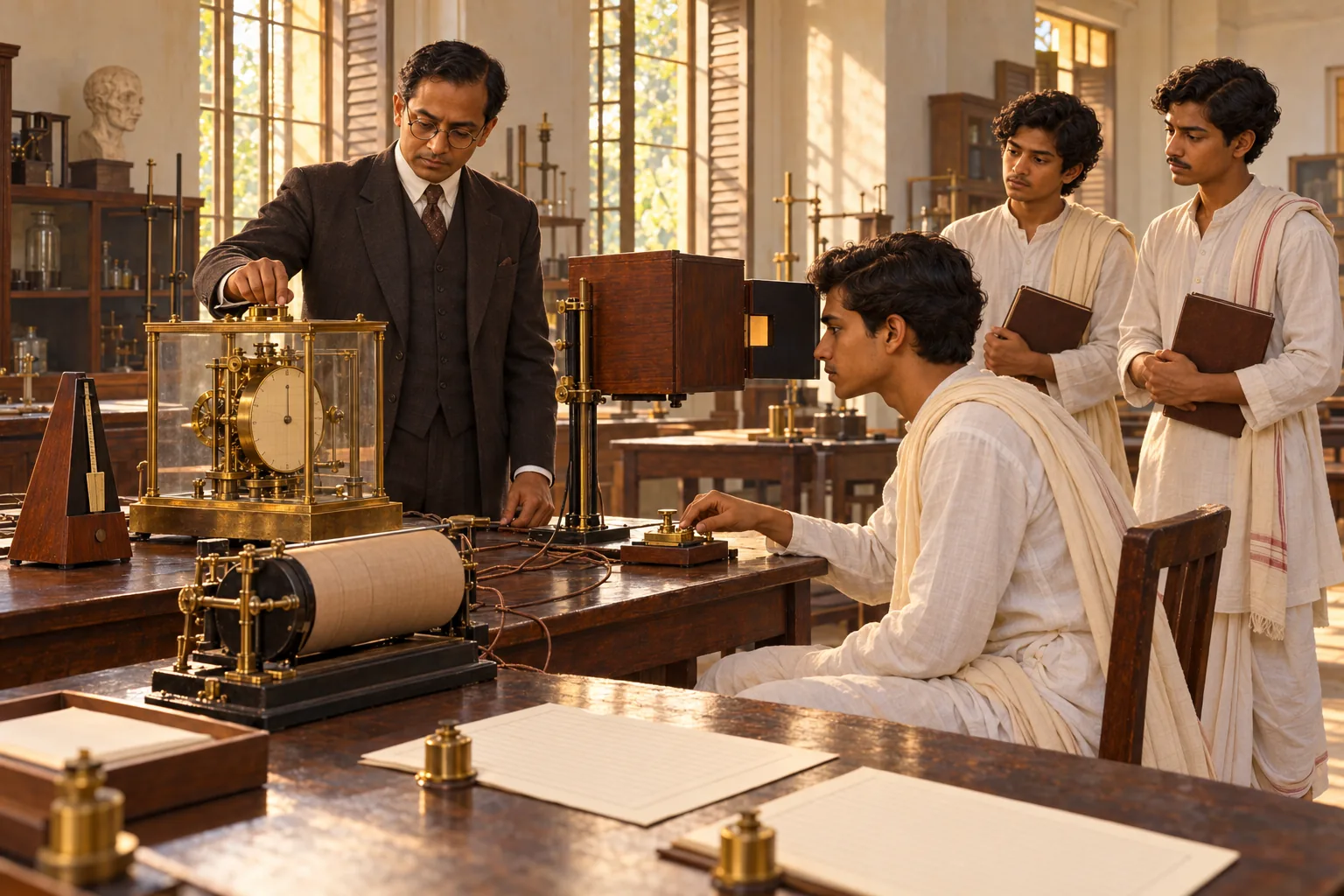 Illustrated reconstruction
An imagined scene, not a portrait of any real person. It shows the kind of laboratory Calcutta's first psychologists worked in. On the table you can see a brass reaction timer in a glass case, a wooden viewing box that shows a picture for a split second, a metronome, a response key that the student presses, and a recording drum that draws a trace on paper. Notice what the students are doing: being measured, not talking about their minds.
What the first Indian psychologists studied
The Calcutta laboratory copied the European model closely. Its research was on depth perception, attention, reaction time and psychophysics, the measurement of how strong a stimulus must be before a person notices it or notices a change in it (Dalal, 2014, pp. 20 to 21). A typical experiment asked a student to press a key as soon as a light appeared, and timed the answer in thousandths of a second.
Two other kinds of Western psychology arrived at the same time.
Psychoanalysis. Girindrasekhar BoseGirindrasekhar BoseIndian doctor and psychoanalyst (1887 to 1953) in Calcutta. He founded the Indian Psychoanalytical Society in 1922 and exchanged letters with Freud.Full entry in the glossary, a medical doctor in Calcutta, took up the ideas of Sigmund FreudSigmund FreudAustrian doctor (1856 to 1939) who founded psychoanalysis. He argued that much of mental life is unconscious. He wrote letters with the Indian psychoanalyst Girindrasekhar Bose.Full entry in the glossary. PsychoanalysispsychoanalysisLiterally: Greek psyche (soul) + analysis (loosening, breaking up)Psychoanalysis is the theory and therapy started by Sigmund Freud. It holds that hidden, unconscious wishes and early childhood experiences shape our feelings and behaviour.Indian link samskaras and vasanas, hidden traces that shape behaviour. The difference: they come from past actions, not mainly from repressed childhood wishes.Full entry in the glossary is the theory and therapy that explains feelings and behaviour through unconscious wishes. Bose earned a doctorate in 1921 with a thesis on repression, the pushing of painful wishes out of awareness. He founded the Indian Psychoanalytical Society in 1922, and he and Freud exchanged letters from 1921 to 1937. Bose later opened the Lumbini Park clinic in Calcutta (1940) and started the journal Samiksha (1947).
Mental testing. In 1924 the University of Mysore opened the second psychology department, headed by M. V. Gopalaswamy. He had trained in London with Charles Spearman, a British pioneer of intelligence testing. Mysore built Indian versions of Western intelligence tests and set up the first laboratory in India for research on animals.
The field also gained the things a discipline needs. Psychology became a section of the Indian Science Congress (included in 1923, first section meeting in 1925 with Sengupta presiding). The Indian Psychological Association was founded in 1924. The first issue of the Indian Journal of Psychology appeared in January 1926. A third department opened at Patna in 1946.
Dates that books report differently
Dalal (2014, p. 20) says the Indian Journal of Psychology "appeared the very next year" after 1924, which would be 1925. Library catalogues date volume 1 to January 1926. Dalal also calls Bose's degree "the first Ph.D. from any Indian University in psychology"; other sources describe it as a D.Sc. "Doctorate" covers both.
Dalal (2014) points out that all three kinds of early psychology, the laboratory, psychoanalysis and testing, were treated as "culture-free". Their founders assumed that a reaction time, an unconscious wish or an intelligence score means the same thing in Calcutta as in Leipzig, Vienna or London. Later Indian psychologists questioned that assumption. You will meet the questioning below.
One early Indian study did travel the other way. After the Bihar earthquake of 1934, Jamuna Prasad (1935) studied the rumours that spread among survivors. The American psychologist Leon Festinger later said this study helped inspire his theory of cognitive dissonance (the discomfort of holding two beliefs that do not fit together), one of the best-known theories in social psychology (Dalal, 2014, p. 21).
Two worlds
Here is a puzzle. Seal, Sengupta and Bose were not cut off from Indian thought. Seal also wrote on science in ancient India and encouraged Jadunath SinhaJadunath SinhaIndian philosopher whose books Indian Psychology, starting with Perception (1934), collected what classical Indian texts say about the mind.Full entry in the glossary to write his volumes on Indian psychology. Sengupta wrote on mysticism. Bose wrote a commentary on the Bhagavad GitaBhagavad Gitaभगवद्गीताBhagavad Gītāsay: bhuh-guh-vuhd gee-taaLiterally: song of the Blessed LordThe Bhagavad Gita is a 700-verse dialogue inside the Mahabharata. Krishna advises the warrior Arjuna, who is in crisis before a battle.Western link Often read as a counselling text: a person in crisis talks with a guide. Unlike most Western therapy, the guide also gives moral and spiritual teaching.Full entry in the glossary for a Bengali magazine. Yet none of this entered the psychology they taught. Their professional work was Western. Their Indian interests stayed private.
Ajit Dalal describes this as living in "two worlds":
They simultaneously lived in two different worlds without any significant overlap.
Dalal (2014, p. 22)
Three different writers have named this split, and you should keep their phrases apart. "Two worlds" is Dalal's phrase. "Double life" is the phrase of the editors of the Foundations textbooks, summarising Dalal: "Right from the beginning, psychologists have led a double life". "A split in the personality, psychologist as a professional vs. psychologist as a person" is Kiran Kumar Salagame's phrase, quoted by Dalal. None of the three is Durganand Sinha's, although Sinha made a similar complaint in 1965, as you will see below.
Why did the split last? Dalal (2014, p. 23) gives two reasons. The colonial rulers saw no practical use for psychology, unlike sociology and anthropology. And the philosophy teachers who moved into the new psychology departments cut themselves off from philosophy, because they wanted to look scientific.
Try this
Dr Anil Kulkarni (an invented example) teaches cognitive behaviour therapy at a university in Hyderabad. In class he says that only methods tested in controlled trials should be used with clients. At home, when his mother is ill, he and his family read the Bhagavad Gita together and visit a temple healer, and he finds this helps them all. He has never mentioned any of it to his students.
How would Ajit Dalal describe Dr Kulkarni's situation, and why did Dalal think this pattern was bad for psychology in India?
Show the reasoning
Dalal would say that Dr Kulkarni lives in "two worlds without any significant overlap": a professional world of Western science and a private world of Indian thought and practice. Dr Kulkarni is not being dishonest. He has simply learned, like many Indian psychologists before him, that the discipline has no place for what helps his own family.
Dalal thought this split was costly. Ideas and practices that clearly matter to Indians, such as the Gita or traditional healing, were never studied or tested by the people best trained to do so. The discipline stayed foreign, and psychologists had little to say about the lives of most Indians. The split also shows why later writers asked for a psychology that starts from Indian experience.
After Independence: rapid growth and a lot of copying (1947 to the 1960s)
India became independent in 1947. Psychology grew fast in the years that followed. In 1950 the government invited the American psychologist Gardner Murphy, through UNESCO, to study the causes of the violence between communities after Partition. His team's report was published as In the Minds of Men (1953). New institutions appeared outside the universities: a psychological bureau in Uttar Pradesh (1947), a defence psychology wing (1949), a textile industry research association in Ahmedabad (1950), and advanced clinical training at the institute in Bangalore that later became NIMHANS (1955). The University Grants Commission, set up in 1956, paid for new departments. By the end of the 1960s there were 32 (Dalal, 2014, pp. 24 to 25).
More departments did not mean more Indian ideas. Most research repeated Western studies on Indian participants. Researchers took an American questionnaire or experiment, used it in India, and reported whether the result came out the same. This is called replication: repeating a study to see whether its findings hold. Replication is useful in science, but a field that only replicates never asks its own questions.
How much was copied?
Mohanty (1988) analysed the papers in the journal Psychological Studies for 1984 and 1985. He found that 85.68 per cent drew mainly on an American source, and 83.67 per cent were replications or near-replications (reported in Sinha, 1994).
The sharpest critic was Durganand SinhaDurganand SinhaIndian psychologist (1922 to 1998) at Allahabad. He led the call to 'indigenize' psychology in India, so that it fits Indian life and problems.Full entry in the glossary, a psychologist at Allahabad. In 1965 he wrote that Indian psychologists, "in their zeal to be scientific", had "shut their eyes to the psychologies of their own systems of thought". The result, he said, was this:
we have at best been able to develop a pale and insipid edition of American or British psychology.
Sinha (1965), reprinted in Psychology for India, ch. 2
In 1974 the political psychologist Ashis Nandy was harsher still: Indian psychology had become "not merely imitative and subservient but also dull and replicative" (quoted in Dalal, 2014, p. 29). Sinha later summed up the period in one line: "Indian researchers were good empiricists but poor theorists" (Sinha, 1989). They collected data carefully, but the ideas that organised the data came from abroad.
The turn to India's problems, and a crisis (1960s to 1980s)
In the 1960s Indian psychologists began to ask what their science could do for the country. India faced poverty, problems in farming, rapid population growth and tension between castescasteLiterally: from Portuguese casta, breed or lineageA caste is a hereditary social group in India. People are born into it and traditionally marry within it. Castes were ranked, and lower-ranked castes faced exclusion and discrimination.Compare Close to social class or to an ethnic group, but caste is fixed at birth, kept by marriage within the group, and was given religious justification. Psychologists study caste prejudice much as they study racial prejudice.Full entry in the glossary and communities. In January 1966 Durganand Sinha gave an address to the Indian Science Congress on psychology and national development. Research started to study these problems directly. Sinha called this problem-oriented research: research chosen because a social problem needs solving, not because a Western journal is interested.
This turn exposed a weakness. Western theories often did not fit. A theory of motivation built on American students said little about a farmer deciding whether to try a new seed, or about a family deciding how many children to have. By the mid-1970s, Dalal (2014, pp. 28 to 29) writes, "a crisis of identity" was "perceptible in the discipline". In 1973 a committee of the Indian Council of Social Science Research commented on the "foreignness" of Indian psychology research. Udai Pareek's review in 1980 and 1981 said the discipline stood at a "crossroads".
Sinha's four phases
Durganand Sinha's book Psychology in a Third World Country: The Indian Experience (1986) gave the best-known account of this history. He described four phases:
-
Pre-Independence
1905 to 1947
Western psychology is transplanted almost whole. It lives inside philosophy, teacher training or medicine.
-
Post-Independence expansion
1947 to the late 1950s
Departments multiply. Western topics are studied on Indian samples, inside Western frameworks.
-
Problem-oriented research
the 1960s
Psychology turns to India's problems: poverty, farming, family planning, caste tension. Western theories prove a poor fit.
-
Indigenization
from the 1970s, stronger from the 1980s
Psychologists question Western concepts and tools, and build measures and theories that fit Indian life.
The phases overlap. Sinha (1994) made a similar point about the different kinds of indigenization, which "have not necessarily occurred in chronological sequence". Treat the phases the same way: as a way of organising the story, not as four clean boxes.
Ajit Dalal's account (2014) covers the same ground in more detail and carries it further. He adds the "two worlds" split, the crisis of identity, and three streams of research that grew after the crisis:
| Stream after the crisis | What it does | Example |
|---|---|---|
| Problem-oriented research | Studies Indian social problems, often with Western methods | Sinha's work on poverty and deprivation (1982) |
| Cross-cultural psychology | Compares groups and cultures to test whether theories hold across them | Studies of Birhor, Asur and Oraon communities in Bihar (Mishra, Sinha and Berry, 1996) |
| Indian psychology | Builds theory from Indian thought: VedantaVedantaवेदान्तVedāntasay: vay-daan-tuhLiterally: end of the VedaVedanta is the family of schools based on the Upanishads. They ask how the self (atman) relates to ultimate reality (Brahman).Western link Sometimes compared with idealist philosophy, which holds that mind or spirit is basic. The key difference: Vedanta claims this can be known by direct experience, not only by argument.Full entry in the glossary, Buddhism, Yoga and the writings of Sri Aurobindo | Rao and Paranjpe's textbook |
Dalal also notes a gap that never closed. J. B. P. Sinha (1993) distinguished the "front" of the discipline, a small number of leading researchers who were doing new indigenous work, from its "bulk", the mass of teaching and research that stayed replicative. As late as 2016, Rao and Paranjpe said most papers at the main national psychology conferences still followed "the old paradigm" (section 1.1.1).
Indigenization
The answer to the crisis had a name: indigenization.
Key concept
indigenization
The word comes from "indigenous", which means belonging naturally to a place. Durganand Sinha defined indigenization as changing borrowed Western psychology "in such a manner that it takes on a character suited to the social and cultural milieu of the country" (Sinha, 1994).
Behind it lies one idea about knowledge. Dalal puts it like this: "The core of indigenization is the belief that all knowledge, including that of psychology, is rooted in the prevalent worldview of a community and is conditioned by historical and socio-cultural factors" (Dalal, 2014, p. 30). If that is true, then Western psychology is not culture-free either. It is the psychology of one region, which happens to be the most powerful one.
Indigenization is not the same as rejecting Western psychology. For Sinha, it was a way to reach psychology that is true for all people, by building it from many cultures instead of assuming one culture speaks for all.
Closest Indian idea no classical term. It is part of modern efforts to renew Indian psychology.
Two directions
Indigenization can move in two directions, and three writers have given the two directions three pairs of names. Students often mix them up, so study this diagram until you can redraw it.
Two directions of indigenization
Three authors, three pairs of names, one distinction. Read each column from top to bottom.
From within
- Starts from
- Concepts, problems and methods that come from Indian thought and life
- What happens
- Psychology is built up from local ideas
- Enriquez (Philippines)
- indigenization from within
- Durganand Sinha
- internal indigenization
- J. B. P. Sinha
- endogenous indigenization
- Indian example
- A scale of non-attachment (anasakti) built from the Bhagavad Gita (Pande and Naidu)
From without
- Starts from
- Theories, tests and methods imported from Western psychology
- What happens
- Imported psychology is adapted to fit local people
- Enriquez (Philippines)
- indigenization from without
- Durganand Sinha
- indigenization of the exogenous
- J. B. P. Sinha
- exogenous indigenization
- Indian example
- Hindi versions of Western intelligence tests
A memory aid: "endo" is Greek for inside and "exo" for outside. Endogenous, internal and from within all mean the same thing. Exogenous, of the exogenous and from without all mean the same thing.
The Filipino psychologist Virgilio EnriquezVirgilio EnriquezFilipino psychologist (1942 to 1994) who founded Sikolohiyang Pilipino (Filipino psychology) and named the difference between indigenization 'from within' and 'from without'.Full entry in the glossary named the two directions first. "Indigenization from without" starts from a foreign theory and adapts it to local people. "Indigenization from within" starts from local concepts, language and practice. Durganand Sinha (1994) used the same distinction with his own names, and J. B. P. SinhaJ. B. P. SinhaIndian organisational psychologist known for the 'nurturant task leader' model (1980), a leader who is both caring and demanding, fitted to Indian workplaces.Full entry in the glossary (2002) called the two kinds "endogenous" and "exogenous".
A good example of indigenization from within is the work of Pande and Naidu on anasaktianasaktiअनासक्तिanāsaktisay: uh-naa-suhk-tiLiterally: non-attachment (an + āsakti, clinging)Anasakti means non-attachment: acting and enjoying life without clinging to things or to results. Indian psychologists study it as a source of calm and happiness.Western link Close to 'non-attachment' in mindfulness research, and to acceptance in acceptance-based therapies. The difference: it is rooted in duty (dharma) and service, not only in managing emotion.Full entry in the glossary, non-attachment. They built a scale from the Gita's description of the steady-minded person who acts without clinging to results. People high on non-attachment reported about the same number of stressful events as others, but significantly less stress and strain (Pande and Naidu, 1992, reported in Sinha, 1994). The concept came from an Indian text, and the method came from Western psychology. The perspectives page returns to this study.
Five ways to get it wrong
Sinha (1994) was a supporter of indigenization, but he listed its traps. Each is a mistake you can spot in student essays and in published papers.
- Cosmetic indigenization. Adding a Sanskrit word or a verse from the Gita to a study that is otherwise entirely Western, just for "local colour".
- Indigenization as a bandwagon. Using it as a slogan, with "more talk than action".
- RevivalismrevivalismPraising old ideas because they are old, and rejecting modern science. Durganand Sinha used the word for an uncritical return to ancient Indian texts.Compare Compare: separation in John Berry's model of acculturation, where a group keeps its own culture and rejects the other. Sinha applied Berry's model to systems of knowledge rather than to people.Full entry in the glossary. Praising whatever is ancient because it is ancient, and turning against science.
- An "Indian versus Western" opposition. Treating the two as enemies, which leads to the claim that every region, even every village, needs its own psychology.
- Cultural parallelism. Listing similarities between Indian and Western ideas without combining them into anything new. Rao and Paranjpe (2016, section 1.2) give an example: finding the Western idea that frustration leads to aggression in the Gita helps Indian psychology no more than ancient Indian ideas about atoms help modern physics.
Sinha also used a model by the cross-cultural psychologist John BerryJohn BerryCross-cultural psychologist known for the ecocultural framework and a model of acculturation. He co-edited Indigenous Psychologies (1993) with Uichol Kim.Full entry in the glossary to describe the possible attitudes to the two kinds of knowledge. Berry's model was built to describe how migrants relate to two cultures. Sinha applied it to Indian psychology's relation to its own tradition and to imported psychology:
| Attitude to Indian tradition | If imported psychology is also valued | If imported psychology is rejected |
|---|---|---|
| Tradition valued | Indigenization: both are valued critically and combined | Revivalism, as in the early 1950s |
| Tradition rejected | The colonial phase: imported psychology valued, Indian thought looked down on | Deculturation: both rejected |
Sinha's hope was indigenization, where both kinds of knowledge are valued and tested. In his words, "the road to universal psychology is through the development of indigenous psychologies" (Sinha, 1994).
The Indian psychology movement (from 2000)
Roots
The idea of an "Indian psychology" is older than the movement. Swami Swami VivekanandaSwami Vivekanandasay: swaa-mee vi-vay-kaa-nuhn-duhIndian monk (1863 to 1902) who presented Vedanta and Yoga to Western audiences, for example in his book Raja Yoga (1896).Full entry in the glossary and Sri AurobindoSri Aurobindosay: shree uh-ro-bin-doIndian thinker and yogi (1872 to 1950) based in Pondicherry. His 'Integral Yoga' describes levels of consciousness, and many Indian psychology writers build on it.Full entry in the glossary are usually named as its early sources (Dalal, 2014, p. 32). Jadunath Sinha's volumes, starting with Indian Psychology: Perception (1934), collected what the classical texts say about the mind. Indra SenIndra SenIndian psychologist and philosopher (1903 to 1994) who coined the term 'integral psychology' for the psychology in Sri Aurobindo's writings.Full entry in the glossary gave a name to the psychology in Aurobindo's writings.
Key concept
integral psychology
Indra Sen coined the name, and set out the system in his book Integral Psychology (1986). "Integral" means whole. The aim is a psychology that includes the body, the emotions and the thinking mind, and also higher levels of consciousness that, in Aurobindo's view, a person can grow into through yoga.
Integral psychology matters for this course because many authors of your textbooks work in this tradition, including Matthijs Cornelissen, who founded the Indian Psychology Institute. When you read their chapters, you are reading one school inside Indian psychology, not the only one.
Compare Compare: transpersonal psychology, which also studies states beyond the ordinary self. Integral psychology differs because it rests on one teacher's system and treats spiritual growth as the main direction of human development.
Interest also came from the West. In 1970 the journal Science published a study of the bodily effects of Transcendental Meditation (a meditation technique based on repeating a mantra, which spread in the West in the 1960s), and Western researchers began to measure yogis in laboratories. Transpersonal psychologytranspersonal psychologyLiterally: Latin trans (beyond) + persona (person)Transpersonal psychology studies experiences that go beyond the personal self, such as mystical states, deep meditation and a sense of unity with all life.Indian link adhyatma vidya, and the study of states such as samadhi and turiya. In this sense Indian psychology was 'transpersonal' from the start.Full entry in the glossary, a Western school that studies experiences beyond the ordinary sense of self, drew heavily on Indian sources. Dalal adds a pointed observation: "So what is 'spiritual psychology' for Western academicians becomes 'revivalism' for Indian academicians!" (Dalal, 2014, p. 22). The same interest that won respect abroad was suspect at home.
Dalal (2014, pp. 32 to 33) lists four reasons why attitudes changed around 2000: growing doubts about what Western psychology had achieved, the worldwide popularity of YogaYogaयोगsay: yo-guhLiterally: joining, yoking; discipline; from yuj-, to yokeYoga is both a school of philosophy and a set of practices that train body, breath and mind. Its classic text is Patanjali's Yoga Sutra.Western link Often compared with mind-body or mindfulness-based interventions. The key difference: classical Yoga is a full ethical and spiritual path, not only a technique for health.Full entry in the glossary, a secular way of reading Indian psychology that does not depend on religious belief, and India's economic rise.
The Pondicherry Manifesto (2002)
From 29 September to 1 October 2002, a National Conference on Yoga and Indian Approaches to Psychology met in Pondicherry (now Puducherry). Its 160 delegates issued the Pondicherry ManifestoPondicherry ManifestoA statement issued by 160 delegates at a conference in Pondicherry in 2002. It called on Indian universities to teach and research Indian psychology, and to write textbooks for it.Full entry in the glossary. It argued that psychology in India was largely an imitation of the West, that Indian thought holds psychological ideas of general value, and that neglecting them explained much of the poor state of the discipline. It described Indian psychology as "pregnant with possibilities for the birth of new models in psychology" (quoted in Dalal, 2014, p. 33).
The manifesto led to concrete work. A smaller group met in Visakhapatnam in 2003 and started the Indian Psychology Book Project, which planned a handbook, a textbook and a sourcebook. Cornelissen and Neeltje Huppes opened the Indian Psychology Institute in Pondicherry in February 2006. The Handbook of Indian Psychology, edited by Rao, Anand C. ParanjpeAnand C. ParanjpeIndian-Canadian psychologist, Professor Emeritus at Simon Fraser University in Canada. He writes on self and identity in Western and Indian thought.Full entry in the glossary and Ajit K. DalalAjit K. DalalIndian psychologist at the University of Allahabad who studied health beliefs and folk healing, and wrote a widely used history chapter on psychology in India.Full entry in the glossary, appeared in 2008. Cornelissen, Misra and Varma edited Foundations of Indian Psychology in two volumes (2011) and a second edition, Foundations and Applications of Indian Psychology (2014). The textbook the project promised became Rao and Paranjpe's Psychology in the Indian Tradition (2016). The sourcebook, they wrote in 2016, had "languished". Two of these books are on your reading list.
What does the movement claim? Rao and Paranjpe are blunt about the discipline they inherited: "What we have in India is a psychology of sorts and not Indian psychology" (2016, section 1.1.1). They also write that if psychology in general suffers from "physics envy", the wish to look like physics, then "psychology in India struggles under 'Western envy'". Dalal adds a caution that is worth keeping: "the purpose of testing ancient Indian theories and knowledge is not to prove their superiority" (Dalal, 2014, p. 35).
Is Indian psychology the same as indigenous psychology?
This is a live debate, and a likely exam question. Indigenous psychologyindigenous psychologyLiterally: Latin indigena, born in a placeIndigenous psychology is psychology that grows from a culture's own ideas, problems and ways of knowing, rather than being imported from elsewhere.Indian link Indian psychology is often called an indigenous psychology, but this is debated. Rao and Paranjpe say Indian psychology carries its own theory, while indigenous psychology is an approach that is neutral about theory.Full entry in the glossary means psychology that grows from a culture's own ideas and problems (the next page explains it fully). Is the Indian psychology movement just India's indigenous psychology? Three answers are on offer:
| Position | Who holds it | The argument |
|---|---|---|
| Not the same | Rao and Paranjpe (2016, section 1.1.2) | Indigenous psychology is "theory neutral": it can be done from a behaviourist, psychoanalytic or any other viewpoint. Indian psychology is "theory-loaded": a school with its own view of the person, like psychoanalysis or behaviourism. |
| Indigenous, and more | Rao (2008, p. 3); Dalal (2014, pp. 32 to 33) | It comes from Indian thought systems, so it is indigenous. But its ideas have "pan human interest", so it claims to be universal. Dalal suggests "psychology of Indian origin" as a better name. |
| One part of indigenization | Durganand Sinha (1997); Rao and Paranjpe say Janak Pandey and Girishwar Misra also blur the two | Sinha described "Indian Psychology" as one facet of indigenization: the facet that works with concepts bound to Indian culture. |
The difference has consequences. If Indian psychology is one indigenous psychology, its findings are claims about Indians, to be compared with other cultures. If it is a school, it claims to describe all human beings, and it must be tested as any school's claims are tested. The scientific-paradigm debate takes up that second road.
Why Indian psychology is needed: the six arguments
Your lectures give six arguments for why psychology needs Indian psychology. Most of them sum up the history on this page and on the perspectives page, so each is short here, with a link to the fuller account.
- Psychology has moved toward social and cultural factors. The Foundations editors, following Dalal, date the shift in two steps: a turn to social problems from the 1970s, and then, in the 1980s, the point when "it was acknowledged that culture played a dominant role in the shaping of the psyche" (Cornelissen, Misra and Varma, 2014, p. xx). Rao and Paranjpe (2016, 1.1.1) draw the conclusion: "Psychology, unlike physics and chemistry, is culture bound." See the crisis of identity and Sinha's four phases.
- The insider's view, not only the observer's. An eticemic and eticsay: ee-mik, e-tikLiterally: from the linguistics terms 'phonemic' and 'phonetic'An emic approach studies a culture from the inside, using its own concepts. An etic approach studies it from the outside, using concepts meant to fit all cultures.Indian link studying a darshana on its own terms (emic) versus comparing it with Western psychology (etic).Full entry in the glossary approach studies people from the outside, with concepts meant to fit every culture. An emic approach studies them from the inside, with their own concepts. Indian research long used Western concepts, built on WEIRD samplesWEIRD samplesLiterally: acronym: Western, Educated, Industrialized, Rich, DemocraticWEIRD stands for Western, Educated, Industrialized, Rich and Democratic. Most psychology research has studied such people, yet presents the results as true for all humans.Indian link none; but the finding supports Indian psychologists' long-standing claim that mainstream findings are not culture-free.Full entry in the glossary, as if they fitted everyone: an "imposed etic". Even research on yoga and meditation is mostly etic, the Foundations editors note, because "the techniques are decontextualized", cut off from the setting that gives them meaning (2014, p. xv). See the perspectives page.
- Psyche, culture, values and personality hang together. When a society changes fast, old values break down before new ones settle, and people feel the conflict inside themselves. Durganand Sinha (1978) studied this in Allahabad in 1969, comparing 300 students, 150 young teachers and 150 older teachers. "Old values have tumbled and the new are still in a state of flux," he wrote. The young chose all their role models from the present day, "very rarely" from "the great personalities of the past", and they hesitated more over moral questions. For Sinha, a mature identity needs "a subjective sense of continuous existence, and a coherent memory", and the young lacked that link with the past. His samples came from one city at one time, so the study shows the problem rather than measuring it for all of India. Dalal's two worlds are the same kind of conflict inside the discipline itself.
- Globalisation brings cultures together. John Pickering (2011, p. 103) warns: "Currently, globalization means Westernization, and hence a loss of cultural diversity." He expects the rise of India and China to bring "a more even balance", in which Indian psychological thought can play a larger part. The Foundations editors add that psychology "as taught at present, all over the world, is still amazingly unicultural" (2014, p. xi), meaning that it comes from one culture. A world in which cultures meet needs more than one culture's picture of the person.
- Imported theories and models did not fit. Western theories often said little about Indian farmers, families and villages, as the crisis of the 1970s showed. Kiran Kumar (2008, p. 24) writes that "all the theories and models of modern psychology cannot explain all the behaviour of Indian masses". This calls for a new understanding, built from Indian life and still tested with sound methods.
- Psychology's goals need an alternative approach. If psychology wants to describe, explain and change human life, it needs the fullest picture of human nature it can find. Rao and Paranjpe (2016, 1.4) offer Indian psychology as "a viable alternative view of human nature". Dalal (2014, p. 35) writes that Indian psychology "calls for a paradigm shift in psychological research", in the sense of the word explained on the paradigm-debate page. He argues that "we need both the paradigms to cover the whole range of human possibilities". The goals of Indian psychology show what such an approach aims at.
Notice that the first five arguments mainly support indigenizationindigenizationIndigenization is the process of making a discipline fit a local culture, either by building it from local ideas or by adapting imported theories and methods.Indian link no classical term. It is part of modern efforts to renew Indian psychology.Full entry in the glossary in general. The sixth is the one that argues most directly for Indian psychology as a school of its own. Durganand SinhaDurganand SinhaIndian psychologist (1922 to 1998) at Allahabad. He led the call to 'indigenize' psychology in India, so that it fits Indian life and problems.Full entry in the glossary, who accepted most of these arguments, still warned against revivalism, cosmetic indigenization and an "Indian versus Western" opposition, and he wanted Indian ideas tested, not simply adopted.
Psychology and policy: Indian Knowledge Systems (from 2020)
The newest phase of the story comes from government policy rather than from psychologists.
Key concept
Indian Knowledge Systems
The National Education Policy (NEP), approved on 29 July 2020, asks for "Knowledge of India" to be part of education, including Indian Knowledge Systems across subjects such as mathematics, philosophy, yoga and medicine. In October 2020 the Ministry of Education set up an IKS Division, based at the All India Council for Technical Education in New Delhi. Its documents list psychology among the fields it supports.
In March 2023 the University Grants Commission issued guidelines on bringing Indian knowledge into higher education. They say that every student "should be encouraged" to take courses in Indian Knowledge Systems worth at least five per cent of their total credits, and that at least half of those credits should relate to the student's main subject. The guidelines also ask that such courses be "based on authentic sources".
Courses like this one fit that policy. For the Indian psychology movement, the policy fulfils the manifesto's first recommendation on a national scale. Some commentators, however, see the push for Indian Knowledge Systems as ideological, and ask what counts as "Indian" knowledge in a country with many religions, languages and traditions, and how a secular university should teach material drawn largely from Hindu texts. Sinha's warnings about revivalism and cosmetic indigenization are a useful test here. A course meets his standard if it reads the traditions critically and tests their claims, not if it simply praises them.
How far the policy facts were checked
The UGC guidelines were read in full. The wording of NEP 2020, paragraph 4.27, and the founding month of the IKS Division were checked only through secondary sources and government press summaries.
Why this history matters for a psychologist
When you use a test. Many tests used in Indian clinics and schools began life in the West and were translated or adapted. That is indigenization from without. Ask who the test was first built for, whether its items mean the same thing to your client, and whether Indian norms exist. Western samples were mostly WEIRD samplesWEIRD samplesLiterally: acronym: Western, Educated, Industrialized, Rich, DemocraticWEIRD stands for Western, Educated, Industrialized, Rich and Democratic. Most psychology research has studied such people, yet presents the results as true for all humans.Indian link none; but the finding supports Indian psychologists' long-standing claim that mainstream findings are not culture-free.Full entry in the glossary, and Indian clients may differ from them.
When you read research. Ask whether a study asks an Indian question or only repeats a Western one on Indian participants. Watch for cosmetic indigenization: a Sanskrit term in the title that does no work in the study.
When you meet a client. Many clients live in two worlds, as Dalal's psychologists did. They may see a psychiatrist and a temple healer in the same week. A psychologist who knows this history is less likely to dismiss either world.
When you study this course. You are studying a course that this movement made possible. The rest of the course will ask you to read Indian ideas closely and, as Sinha and Dalal both insisted, to test them rather than simply admire them.
Try this
Ritu (an invented example), an MSc student in Mysuru, is planning her dissertation. She has two ideas. Idea A: translate a well-known American test of exam anxiety into Kannada and give it to 300 college students. Idea B: interview farmers in Mandya district about how they bear long periods of hardship, and build a measure of the endurance they describe, using their own words. Her supervisor also notices that Ritu plans to open Idea A with a verse from the Bhagavad Gita about steadiness of mind, which is not used anywhere else in the study.
Classify each idea as indigenization from within or from without, giving all three pairs of names. Then say which of Sinha's pitfalls the supervisor is worried about, and why.
Show the reasoning
Idea A starts from an imported tool and adapts it to local people. It is indigenization from without: Enriquez's "from without", Durganand Sinha's "indigenization of the exogenous", and J. B. P. Sinha's "exogenous indigenization". Idea B starts from local experience and local words and builds a concept from them. It is indigenization from within: Enriquez's "from within", Durganand Sinha's "internal indigenization", and J. B. P. Sinha's "endogenous indigenization". Both are useful. Idea A makes an existing tool fairer for Kannada speakers. Idea B could produce a concept that Western psychology does not have.
The supervisor is worried about cosmetic indigenization. A Gita verse placed at the start of a study that is otherwise entirely Western adds "local colour" but does no work: it does not shape the questions, the measure or the interpretation. Sinha (1994) warned that this makes research appear "rooted in the Indian soil" without being so. If Ritu thinks the Gita's idea of a steady mind matters for exam anxiety, she should build it into the study, for example by measuring it, rather than quoting it as decoration.