Unit 1 Topic 1 of 8
Ancient forms and the missing name
Syllabus Ancient form and absence of nomenclature
Imagine you could walk into a place of learning in India two thousand years ago and ask for the books on psychology. Nobody would understand the question. There was no such subject, and no word for it. In the words of the Indian scholar S. K. Ramachandra Rao, as reported by Kiran Kumar (2008, p. 25), "our ancient thinkers did not give psychology an independent educational status as a branch of knowledge, nor do we find an exact word for psychology in Sanskrit".
Yet if you read the texts that did exist, you would keep meeting questions that psychologists ask today. The same scholar notes that the ancient thinkers "necessarily addressed psychological topics such as consciousness, experience, perception, illusion, will, desires, emotions and others" (Kiran Kumar, 2008, p. 25). The ideas were there. The name and the separate subject were not.
The syllabus calls this the "ancient form and absence of nomenclaturenomenclaturesay: no-men-kluh-chuhrLiterally: Latin nomenclatura, a calling of namesA system of names for the things in a field. The 'absence of nomenclature' means ancient India had no name for psychology as a separate subject.Indian link adhyatma vidya, 'knowledge of the self', the nearest old name for the field.Full entry in the glossary" of Indian psychology. This page answers four questions. Where do the old ideas about the mind live? Why was there no separate subject called psychology? What did the tradition call this knowledge instead? And when did the modern names arrive?
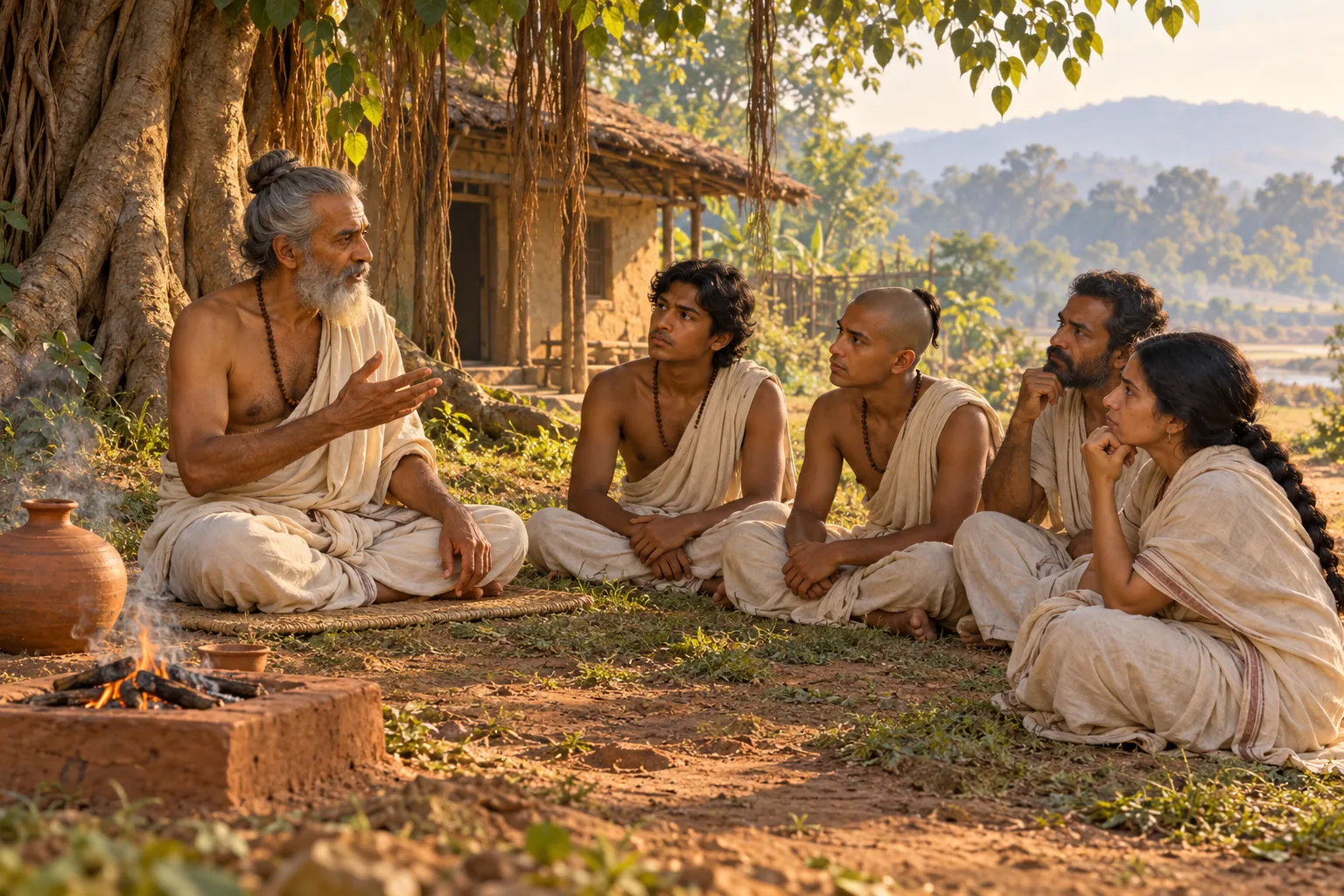 Illustrated reconstruction
An imagined scene from around 700 BCE, the time of the early Upanishads. Notice what is missing: books. For centuries Indian teachings were memorised and passed on by speech, from teacher to student. The word Upanishad is usually explained as "sitting down near" a teacher. This is one reason the old ideas about the mind are scattered: they were taught inside whole ways of life, not collected into a textbook.
Where the ideas live
Psychological ideas in India are spread across many kinds of texts: hymns, philosophical dialogues, an epic, Buddhist and Jain scriptures, the manuals of the schools, a medical text and a book on drama. Kiran Kumar (2008, p. 42) suggests a rough map from each source to the part of modern psychology it speaks to. The table below follows his map, with mainstream dates.
| Source | Rough date | Psychological topics | Nearest field today |
|---|---|---|---|
| VedasVedaवेदsay: vay-duhLiterally: knowledge; from vid-, to knowThe Vedas are the oldest sacred texts of India. They are hymns, ritual guides and teachings, first passed on by memory and recitation.Full entry in the glossary | from c. 1500 BCE | Words for mind; desire; charms for healing | The language of mind; folk healing |
| UpanishadsUpanishadउपनिषद्Upaniṣadsay: u-puh-ni-shuhdLiterally: sitting down near (a teacher); upa + ni + sadThe Upanishads are philosophical texts at the end of the Vedas. They ask what the self is and how it relates to the whole of reality.Western link Sometimes compared to Plato's dialogues, because they teach through questions and conversation. The key difference: their aim is direct experience of the self, not only a sound argument.Full entry in the glossary | from c. 700 BCE | The self; waking, dream and deep sleep; layers of the person | Self and consciousness |
| Bhagavad GitaBhagavad Gitaभगवद्गीताBhagavad Gītāsay: bhuh-guh-vuhd gee-taaLiterally: song of the Blessed LordThe Bhagavad Gita is a 700-verse dialogue inside the Mahabharata. Krishna advises the warrior Arjuna, who is in crisis before a battle.Western link Often read as a counselling text: a person in crisis talks with a guide. Unlike most Western therapy, the guide also gives moral and spiritual teaching.Full entry in the glossary | around 200 BCE (debated) | A steady mind; how desire turns to anger; action without attachment | Motivation, emotion, counselling |
| Buddhist texts and the AbhidhammaAbhidhammaअभिधम्मsay: uh-bhi-dhuhm-muhLiterally: higher teaching; (teaching) about the dhammaThe Abhidhamma is the part of Buddhist scripture that analyses the mind in detail. It lists the mental states and factors that make up experience.Western link Close to a classification of mental states in cognitive psychology. The key difference: it is built from trained introspection in meditation and aims at ethical change and freedom from suffering.Full entry in the glossary | from the 5th century BCE | Suffering and craving; the parts of experience; lists of mental states | Cognition, emotion, mindfulness |
| Jain texts | from the 6th or 5th century BCE | The soul and karmakarmaकर्मsay: kuhr-muhLiterally: action, deed; from kṛ-, to doKarma means action, and also the result that every action brings back to the person who did it, in this life or a later one.Western link Close to moral causation, or 'you reap what you sow'. The difference: in most schools karma is an impersonal law that works across lives; theistic schools say God oversees it, but even there it is not a judge's verdict on a single life.Full entry in the glossary; truth seen from many sides | Perspective-taking |
| SankhyaSankhyaसांख्यSāṃkhyasay: saang-khyuhLiterally: enumeration, countingSankhya explains everything with two realities: pure consciousness (purusha) and nature (prakriti). In Sankhya, the mind belongs to nature, not to consciousness.Western link Close to mind-body dualism, as in Descartes. The key difference: Sankhya puts the mind on the material side; only pure consciousness is separate.Full entry in the glossary and YogaYogaयोगsay: yo-guhLiterally: joining, yoking; discipline; from yuj-, to yokeYoga is both a school of philosophy and a set of practices that train body, breath and mind. Its classic text is Patanjali's Yoga Sutra.Western link Often compared with mind-body or mindfulness-based interventions. The key difference: classical Yoga is a full ethical and spiritual path, not only a technique for health.Full entry in the glossary | Yoga Sutra c. 1st to 2nd century CE | The mind as a kind of matter; three qualities of nature; calming the mind | Personality, attention, self-regulation |
| NyayaNyayaन्यायNyāyasay: nyaa-yuhLiterally: rule, method, standard; 'that into which a thing goes back' (ni + i-, to go)Nyaya is the Indian school of logic and of the theory of knowledge. It studies how we can know things correctly and how to argue well.Western link Close to logic and epistemology in Western philosophy. The differences: Nyaya also aims at liberation, and its inference always includes an example from experience.Full entry in the glossary and VaisheshikaVaisheshikaवैशेषिकVaiśeṣikasay: vai-shay-shi-kuhLiterally: concerned with particulars (viśeṣa)Vaisheshika is the school that sorts everything that exists into basic categories. It taught that physical things are made of tiny atoms.Western link Close to Greek atomism and to Aristotle's list of categories. Unlike Greek atomism, it counts selves and minds as separate substances.Full entry in the glossary | dates uncertain | Perception, inference and error; the mind as an inner sense | Cognitive psychology; individual differences |
| MimamsaMimamsaमीमांसाMīmāṃsāsay: mee-maam-saaLiterally: desire to reflect; inquiryMimamsa is the school that interprets the Vedas, mainly their rules for ritual and duty (dharma). Its founding text is Jaimini's Mimamsa Sutra.Western link Close to hermeneutics, the theory of interpretation, applied to sacred rules. It also resembles legal reasoning about how to read a law.Full entry in the glossary | dates uncertain | Duty and the motives for action | Motivation |
| AyurvedaAyurvedaआयुर्वेदĀyurvedasay: aa-yur-vay-duhLiterally: knowledge of life (āyus + veda)Ayurveda is India's traditional system of medicine. It treats body and mind together and aims to keep health in balance, not only to cure illness.Western link Close to holistic or biopsychosocial medicine. The key difference: its concepts (doshas, gunas) do not match Western physiology, and its care includes diet, daily routine and ethics.Full entry in the glossary (the Charaka SamhitaCharaka SamhitaचरकसंहिताCarakasaṃhitāsay: chuh-ruh-kuh suhm-hi-taaLiterally: the compendium of CarakaThe Charaka Samhita is the oldest major text of Ayurveda. It covers health, disease and treatment, and it has much to say about the mind.Western link Comparable to the Hippocratic writings of Greek medicine as a founding medical text. It differs in giving a full place to the mind and to ethics in health.Full entry in the glossary) | c. 100 BCE to 200 CE (uncertain) | Suffering of the mind; judgement and health; good conduct | Health and clinical psychology |
| NatyashastraNatyashastraनाट्यशास्त्रNāṭyaśāstrasay: naat-yuh-shaas-truhLiterally: treatise on dramaThe Natyashastra is an ancient book on drama, dance and music, credited to Bharata. It contains an early theory of emotion called rasa.Western link Close to theories of basic emotions and of audience response in drama. The key difference: rasa is a shared, aesthetic emotion that is enjoyed, not a private reaction.Full entry in the glossary | 2nd century BCE to 2nd century CE | Emotions, their causes and signs, and how an audience feels them | Emotion |
The rest of this section gives one concrete example from each of the main sources. You do not need to remember every detail. The point is to see how much of psychology's ground these texts already covered, and in what form.
The Vedas: the mind as a puzzle
The Rig VedaRig Vedaऋग्वेदṚgvedasay: rig-vay-duhLiterally: Veda of verses; ṛc, a verse of praiseThe Rig Veda is the oldest of the four Vedas. It is a collection of 1,028 hymns to gods and powers of nature, arranged in ten books.Full entry in the glossary already treats the mind as something that can trap us. One hymn says: "What thing I truly am I know not clearly; mysterious, fettered in my mind I wander" (1.164.37). The famous creation hymn calls desire "the first seed of mind" (10.129). R. L. Kashyap (2011), drawing on earlier work by Purani, counts about 36 different words for mental operations in the Vedas.
A warning from the scholar R. N. Dandekar (1941, reported in Kiran Kumar, 2008) applies here. In the early Vedas, manasmanasमनस्say: muh-nuhsLiterally: mind; from man-, to thinkManas is the everyday mind. It receives what the senses bring, links it together, and wavers between options. It is a tool of the self, not the self.Western link Close to 'mind' as a processor of sensory input, or to attention and working memory. The key difference: manas is not conscious by itself; the self gives it awareness.Full entry in the glossary seems to have been pictured almost as a physical substance in the body. Reading a modern idea of "mind" back into these hymns would be a mistake. The later Atharva Veda includes charms to cure disease, lengthen life and win love: an early record of how people tried to heal body and mind together.
The Upanishads: what is the self?
The UpanishadsUpanishadउपनिषद्Upaniṣadsay: u-puh-ni-shuhdLiterally: sitting down near (a teacher); upa + ni + sadThe Upanishads are philosophical texts at the end of the Vedas. They ask what the self is and how it relates to the whole of reality.Western link Sometimes compared to Plato's dialogues, because they teach through questions and conversation. The key difference: their aim is direct experience of the self, not only a sound argument.Full entry in the glossary turn the question inward. Who is it that sees, hears and thinks? One of the oldest, the Brihadaranyaka, gives a list of what the mind contains: "Desire, determination, doubt, faith, steadfastness, shame, intellection, fear, all this is truly mind" (1.5.3, quoted in Rao and Paranjpe, 2016, 4.1.3). Intellection here simply means thinking. That list would not look out of place in a modern textbook chapter on motivation and emotion.
The Upanishads also describe three everyday states: waking, dreaming and dreamless sleep, and they ask what stays the same across all three. They describe the person in layers, from the physical body inward (the pancha koshapancha koshaपञ्चकोशpañcakośasay: puhn-chuh ko-shuhLiterally: five sheathsPancha kosha means the five sheaths of the person: body, breath, mind, understanding and bliss. Each is subtler than the one before.Western link Close to holistic or biopsychosocial models of the person. The difference: it adds a layer of bliss and places the true self beyond all five.Full entry in the glossary). The Chandogya even says that "mind is made of food" (6.5.4), a strikingly bodily view. Behind all these runs one central idea: the true self, atmanatmanआत्मन्ātmansay: aat-muhnLiterally: self; in early use also 'breath'Atman means the self: the deepest 'I' behind body and mind. In Vedanta it is pure consciousness and is one with Brahman.Western link Close to 'self' or 'soul'. The key difference: Western psychology studies the self as a set of thoughts and traits; atman is the conscious witness of them.Full entry in the glossary, is the knower, not anything that can be known. The perspectives on reality page explains these ideas fully.
The chariot: a picture of self-control
The best-known picture of the mind in Indian thought comes from the Katha Upanishad. It compares a person to a chariot pulled by horses.
The chariot: a picture of the person
Katha Upanishad 1.3.3 to 1.3.4. Read from the top: each part should guide the one below it. The chariot itself is the body that carries them all.
- In the pictureThe master who rides in the chariot In the person The self (atmanatmanआत्मन्ātmansay: aat-muhnLiterally: self; in early use also 'breath'Atman means the self: the deepest 'I' behind body and mind. In Vedanta it is pure consciousness and is one with Brahman.Western link Close to 'self' or 'soul'. The key difference: Western psychology studies the self as a set of thoughts and traits; atman is the conscious witness of them.Full entry in the glossary) Does not drive. It is the one for whom the whole journey happens.
- In the pictureThe charioteer, who drives In the person The intellect (buddhibuddhiबुद्धिsay: bud-dhiLiterally: awakening, understanding; from budh-, to wake, to knowBuddhi is the intellect: the part of the mind that decides, judges and understands. In Sankhya it is the first and finest product of nature.Western link Close to 'intellect' or to the executive functions of decision and judgement. The key difference: in Sankhya, buddhi is material and only seems conscious because it reflects purusha.Full entry in the glossary) Decides where to go and pulls the reins.
- In the pictureThe reins In the person The mind (manasmanasमनस्say: muh-nuhsLiterally: mind; from man-, to thinkManas is the everyday mind. It receives what the senses bring, links it together, and wavers between options. It is a tool of the self, not the self.Western link Close to 'mind' as a processor of sensory input, or to attention and working memory. The key difference: manas is not conscious by itself; the self gives it awareness.Full entry in the glossary) Links the driver to the horses. Through it, decisions reach the senses.
- In the pictureThe horses In the person The senses (indriyaindriyaइन्द्रियsay: in-dri-yuhLiterally: belonging to Indra; power, facultyIndriyas are the sense powers. Five are for knowing (hearing, touch, sight, taste, smell) and five are for action (speech, hands, feet, excretion, reproduction).Western link Close to the sensory and motor systems in psychology. The difference: action organs count as senses too, and manas is treated as an inner sense.Full entry in the glossary) Strong and eager. They pull towards whatever attracts them.
- In the pictureThe roads the horses run on In the person The objects of the senses Sights, sounds, smells, tastes and touches.
- In the pictureThe chariot itself In the person The body Carries all of the above. In the order of control it comes lowest, below the senses (Bhagavad Gita 3.42).
The Bhagavad Gita (3.42) gives the same order: the senses are higher than the body, the mind higher than the senses, the intellect higher than the mind, and the self highest of all. Source: Paranjpe and Rao (2008), p. 265.
The picture is about control. The horses (the senses) are strong and pull towards whatever attracts them. The reins (the mind) can pass on a direction, but only if the driver (the intellect) holds them firmly and knows where to go. The master riding in the chariot (the self) is the one for whom the journey happens. Paranjpe and Rao (2008, p. 265) note that this gives the mind a clear order of command, and that the Bhagavad Gita (3.42) repeats the same order.
Verse numbers
The chariot passage is Katha Upanishad 1.3.3 to 1.3.4 in the usual numbering. Some editions number the chapters continuously and call it 3.3 to 3.4. Both refer to the same verses.
Try this
Kavya, a first-year student in Pune (an invented example), sits down to study for three hours. Every few minutes her phone lights up and she checks it. She knows she should not, and she feels annoyed with herself each time, but she keeps doing it.
Describe Kavya's evening using the parts of the Katha chariot. Which part is failing, and what would the chariot picture suggest she train?
Show the reasoning
The horses are her senses, which are drawn to the bright screen and the sound of a message, the "roads" they want to run on. The reins are her mind (manas), which should carry her decision to the senses. The driver is her intellect (buddhi), which has already decided that studying matters more. The trouble is that the decision does not reach the horses: the reins are slack, so the senses pull the chariot wherever the next message leads.
The picture suggests that the answer is not to fight the horses at every moment, but to train the driver and tighten the link between driver and reins: deciding clearly and in advance, and practising steady attention so that a decision holds. A modern psychologist would talk about self-regulation and attention control, and might suggest removing the phone from the room. The chariot picture adds a further claim: that the self is not the restless part, so Kavya can watch her own pull towards the phone without being it.
The Bhagavad Gita: from a passing thought to ruin
The Bhagavad GitaBhagavad Gitaभगवद्गीताBhagavad Gītāsay: bhuh-guh-vuhd gee-taaLiterally: song of the Blessed LordThe Bhagavad Gita is a 700-verse dialogue inside the Mahabharata. Krishna advises the warrior Arjuna, who is in crisis before a battle.Western link Often read as a counselling text: a person in crisis talks with a guide. Unlike most Western therapy, the guide also gives moral and spiritual teaching.Full entry in the glossary is a dialogue set on a battlefield, inside the MahabharataMahabharataमहाभारतMahābhāratasay: muh-haa-bhaa-ruh-tuhLiterally: the great (story of the) BharatasThe Mahabharata is a very long Sanskrit epic about a war between two related royal families. The Bhagavad Gita is one part of it.Western link Often compared with Homer's Iliad. It is much longer, and it contains whole books of moral and philosophical teaching.Full entry in the glossary. It is a conversation between the warrior prince Arjuna, who has lost his nerve before the battle, and his charioteer Krishna, whom the text presents as God in human form. In one famous passage (2.62 to 2.63) it traces how a small mental act grows into disaster. In Radhakrishnan's translation: "When a man dwells in his mind on the objects of sense, attachment to them is produced. From attachment springs desire and from desire comes anger" (quoted in Rao and Paranjpe, 2016, 4.1.1). The chain continues:
-
Dwelling on an object
The mind keeps returning to something the senses have shown it.
-
Attachment
A pull towards the object forms.
-
Desire
The pull becomes wanting.
-
Anger
When the wanting is blocked, anger follows.
-
Confusion
Anger clouds thinking.
-
Loss of memory
The person forgets what they knew and valued.
-
Loss of judgement
The intellect stops working.
-
Ruin
The person is destroyed.
The Gita's answer is a person of steady mind, who "moves among the objects of sense" with the senses "under control and free from attachment and aversion" (2.64). Its best-known teaching on action, nishkama karmanishkama karmaनिष्काम कर्मniṣkāma karmasay: nish-kaa-muh kuhr-muhLiterally: action without desire (niṣ + kāma + karma)Nishkama karma means doing one's duty without craving its results. The Bhagavad Gita teaches it as a way to act fully while staying calm and free.Western link Close to intrinsic motivation and to focusing on the process rather than the outcome. The difference: it is a spiritual discipline, with action offered as duty or to God.Full entry in the glossary, asks people to act fully but without clinging to the results.
Buddhism: taking experience apart
Early Buddhism, which follows the teaching of the Buddhathe Buddhaबुद्धBuddhasay: bud-dhuhLiterally: the awakened oneThe teacher whose teachings became Buddhism. He lived in north India, probably in the 5th century BCE, and taught a path out of suffering through ethics, meditation and insight.Full entry in the glossary, starts from the fact of suffering (dukkhadukkhaदुक्खsay: duk-khuhLiterally: uneasy, hard to bear (Sanskrit duḥkha: 'bad space'; opposite of sukha)Dukkha means suffering or unsatisfactoriness. In Buddhism, the first noble truth is that life as usually lived is marked by dukkha.Western link Close to 'suffering', 'distress' or 'dissatisfaction' in psychology. The difference: dukkha includes a quiet unease even in pleasant states, because they do not last.Full entry in the glossary) and its cause, craving. Its method is to look closely at experience and take it apart. It describes a person as five "heaps" or skandhasskandhaस्कन्धsay: skuhn-dhuhLiterally: heap, bundle; trunkThe skandhas are the five 'heaps' that make up a person in Buddhism: body, feeling, perception, mental formations and consciousness.Western link Close to a model of the mind in parts: body, affect, perception, motivation and awareness. The difference: the list is used to show that there is no self beyond the parts.Full entry in the glossary: bodily form, feeling, perception, mental formations such as intentions, and consciousness. It names six kinds of consciousness, one for each of the five senses and a sixth, "mind-consciousness", which knows thoughts.
Later Buddhist scholars built this into the Abhidhamma, a systematic analysis of mental life (the AbhidhammaAbhidhammaअभिधम्मsay: uh-bhi-dhuhm-muhLiterally: higher teaching; (teaching) about the dhammaThe Abhidhamma is the part of Buddhist scripture that analyses the mind in detail. It lists the mental states and factors that make up experience.Western link Close to a classification of mental states in cognitive psychology. The key difference: it is built from trained introspection in meditation and aims at ethical change and freedom from suffering.Full entry in the glossary card explains the word). One handbook of the tradition lists 52 elements of consciousness. Seven of them are present in every moment of experience: contact, feeling, volition, perception, one-pointed concentration, life, and attention (Rao and Paranjpe, 2016, 3.3). The aim of all this careful analysis was practical: to see that there is no lasting self behind the parts (anattaanattaअनत्ताanattāsay: uh-nuht-taaLiterally: not-self (Sanskrit an + ātman)Anatta is the Buddhist teaching of 'no-self': there is no lasting, unchanging self behind our experiences. A person is a changing process.Western link Close to David Hume's 'bundle' view of the self, and to modern views of the self as something the brain constructs. The difference: anatta is meant to be seen in meditation, and seeing it frees from suffering.Full entry in the glossary), and so to end suffering.
Nyaya: how perception works
The NyayaNyayaन्यायNyāyasay: nyaa-yuhLiterally: rule, method, standard; 'that into which a thing goes back' (ni + i-, to go)Nyaya is the Indian school of logic and of the theory of knowledge. It studies how we can know things correctly and how to argue well.Western link Close to logic and epistemology in Western philosophy. The differences: Nyaya also aims at liberation, and its inference always includes an example from experience.Full entry in the glossary school is best known for its theory of valid knowledge, and it explains perception step by step. According to the commentator Vatsyayana, perception happens when the self comes into contact with the mind, the mind with a sense organ, and the sense organ with an object (Rao and Paranjpe, 2016, 4.1.4). In this school the mind (manasmanasमनस्say: muh-nuhsLiterally: mind; from man-, to thinkManas is the everyday mind. It receives what the senses bring, links it together, and wavers between options. It is a tool of the self, not the self.Western link Close to 'mind' as a processor of sensory input, or to attention and working memory. The key difference: manas is not conscious by itself; the self gives it awareness.Full entry in the glossary) is an inner sense organ. It is extremely small, "restless and constantly moving", and it guides the outer senses and joins their reports together. The self, not the mind, is the one who knows.
How do we know there is a self at all, if we cannot see it? Nyaya argues from experience: desire, memory and recognition need a single owner who persists over time. Pleasure, pain, desire, hatred, will and cognition are listed as qualities of the self. Kiran Kumar (2008, p. 42) suggests that Nyaya could feed a cognitive psychology, one that also counts intuition as a source of knowledge.
Ayurveda: suffering of the mind
The Charaka SamhitaCharaka SamhitaचरकसंहिताCarakasaṃhitāsay: chuh-ruh-kuh suhm-hi-taaLiterally: the compendium of CarakaThe Charaka Samhita is the oldest major text of Ayurveda. It covers health, disease and treatment, and it has much to say about the mind.Western link Comparable to the Hippocratic writings of Greek medicine as a founding medical text. It differs in giving a full place to the mind and to ethics in health.Full entry in the glossary, the founding text of AyurvedaAyurvedaआयुर्वेदĀyurvedasay: aa-yur-vay-duhLiterally: knowledge of life (āyus + veda)Ayurveda is India's traditional system of medicine. It treats body and mind together and aims to keep health in balance, not only to cure illness.Western link Close to holistic or biopsychosocial medicine. The key difference: its concepts (doshas, gunas) do not match Western physiology, and its care includes diet, daily routine and ethics.Full entry in the glossary, India's classical medicine, treats body and mind as one system. It names three kinds of suffering: arising in the body, coming from outside, and arising in the mind (Charaka Samhita 1.11.45, in Kapoor, 2014, p. 224).
Charaka also asks why people fall ill when they know how to stay well. His answer is a failure of judgement, prajnaparadhaprajnaparadhaप्रज्ञापराधprajñāparādhasay: pruhg-yaa-puh-raa-dhuhLiterally: an offence (or failure) of the intellectIn Ayurveda, a failure of judgement: knowing better but acting against it. Charaka treats it as a root cause of illness.Western link Close to ideas in health psychology about poor self-regulation and the gap between knowing and doing. The difference: Charaka treats it as a moral and cognitive failure together.Full entry in the glossary: the intellect fails to tell good from harmful, self-restraint fails to hold back, and memory fails to recall what one has learned (Charaka Samhita 4.1.98, in Kapoor, 2014, p. 224). The cure includes good conduct and a steady mind, not only medicine.
The Natyashastra: a theory of emotion
The most detailed classical study of emotion comes from an unexpected place: a manual for actors. The NatyashastraNatyashastraनाट्यशास्त्रNāṭyaśāstrasay: naat-yuh-shaas-truhLiterally: treatise on dramaThe Natyashastra is an ancient book on drama, dance and music, credited to Bharata. It contains an early theory of emotion called rasa.Western link Close to theories of basic emotions and of audience response in drama. The key difference: rasa is a shared, aesthetic emotion that is enjoyed, not a private reaction.Full entry in the glossary, credited to BharataBharataभरतsay: bhuh-ruh-tuhThe author named for the Natyashastra, the classical Indian treatise on drama, which contains a detailed theory of emotions and how audiences feel them.Full entry in the glossary, set out to teach performers how to show every human feeling on stage. To do that, it first had to describe the feelings.
Bharata names eight lasting emotions (bhavasbhavaभावbhāvasay: bhaa-vuhLiterally: becoming, state of being; feelingAn emotion or feeling. Bharata named eight lasting emotions (sthayi bhava), such as love, sorrow and fear, and thirty-three passing ones.Western link Close to 'emotion' in psychology, and Bharata's eight lasting emotions resemble modern lists of basic emotions. The difference: Bharata studied them mainly to show them on stage.Full entry in the glossary) and thirty-three passing ones, such as anxiety, shame, joy and despair. For each, he describes its causes and its outward signs: words, gestures, and bodily changes such as sweating, trembling, a breaking voice, tears and changes of skin colour (Rao and Paranjpe, 2016, 6.2.1). He treats the lasting emotions as shared with animals, and he also recognises that social convention shapes how emotions are expressed.
New Sanskrit word
rasa रस
Bharata's most original idea answers a puzzle: why do people enjoy watching a sad play? In real life, sorrow hurts. In the theatre, the same sorrow becomes something the audience savours. Bharata calls the emotion as the audience tastes it a rasa. Each lasting emotion has its own rasa.
| Lasting emotion (bhava) | Its rasa in art |
|---|---|
| Erotic love (rati) | Love (shringara) |
| Mirth (hasa) | The comic (hasya) |
| Sorrow (shoka) | Pathos (karuna) |
| Anger (krodha) | The furious (raudra) |
| Energy or enthusiasm (utsaha) | The heroic (vira) |
| Fear (bhaya) | Horror (bhayanaka) |
| Disgust (jugupsa) | The odious (bibhatsa) |
| Astonishment (vismaya) | The marvellous (adbhuta) |
A rasa is not a private feeling. It is shared by the audience, held at a little distance, and so it can be enjoyed. The later philosopher Abhinavagupta (around 1000 CE) developed this theory further (Rao and Paranjpe, 2016, 6.2).
Nearest Western idea Close to theories of aesthetic emotion, and to the question of why tragedy pleases. The key difference: rasa is a shared, impersonal emotion that is savoured, not the private feeling itself.
Yoga, Jainism and the rest
A few more sources complete the picture.
- Yoga. PatanjaliPatanjaliपतञ्जलिPatañjalisay: puh-tuhn-juh-liThe compiler of the Yoga Sutras, a short classical text on training the mind. Most scholars date it to the 1st or 2nd century CE, and no later than the 5th century.Full entry in the glossary's Yoga SutraYoga Sutraयोगसूत्रYogasūtrasay: yo-guh soo-truhLiterally: threads (aphorisms) on yogaThe Yoga Sutra is the classic text of the Yoga school, by Patanjali. In about 195 short lines it explains how to calm and master the mind.Western link Close to a manual of attention training and self-regulation. The key difference: its goal is the freedom of pure consciousness (purusha), not only better mental health.Full entry in the glossary, a text of 195 or so short sutrassutraसूत्रsūtrasay: soo-truhLiterally: threadA sutra is a very short sentence that holds a teaching in a few words. Whole texts were written this way so that students could learn them by heart.Western link Close to an aphorism or a numbered list of propositions. Unlike most Western aphorisms, sutras were meant to be read with a long commentary.Full entry in the glossary, defines yoga as the stilling of the movements (vrittisvrittiवृत्तिvṛttisay: vrit-tiLiterally: turning, whirl; activityA vritti is a movement or wave in the mind: any thought, perception, memory or other mental event. Yoga aims to calm the vrittis.Western link Close to a 'mental event' or the stream of thought in cognitive psychology. The difference: sleep and memory count as vrittis, and the aim is to quiet them, not to study them.Full entry in the glossary) of the mind. It describes the afflictions that disturb the mind (kleshaskleshaक्लेशkleśasay: klay-shuhLiterally: affliction, pain, troubleKleshas are the afflictions of the mind that cause suffering. Yoga names five: ignorance, I-am-ness, attachment, aversion and clinging to life.Western link Close to the patterns of thought and emotion that cause distress in clinical psychology. The difference: the root cause is a mistaken sense of self, not a learned belief.Full entry in the glossary), the traces that past actions leave (samskarassamskaraसंस्कारsaṃskārasay: suhm-skaa-ruhLiterally: putting together, refining; impressionA samskara is a mental impression left by past experience or action. Samskaras shape later habits, reactions and desires, often without our knowing.Western link Close to a memory trace, a habit or a schema. The difference: samskaras are thought to carry over from past lives as well.Full entry in the glossary), and an eight-step path that includes withdrawing the senses and concentration. Rao and Paranjpe (2016) call Yoga "clearly the foundational source of Indian psychology". Unit 2 studies its methods and Unit 5 its practices.
- Jainism. Jain thinkers wrote about the soul (jivajivaजीवjīvasay: jee-vuhLiterally: living being; from jīv-, to liveJiva means a living being: the individual self that has a body, a mind and a life story. It is the self as it lives in the world.Western link Close to 'person' or 'the embodied self' in psychology. The difference: the jiva is thought to continue across many lives.Full entry in the glossary) and karma, and taught that one thing can be truly seen from many sides (anekantavadaanekantavadaअनेकान्तवादanekāntavādasay: uh-nay-kaan-tuh-vaa-duhLiterally: doctrine of not-one-sidednessAnekantavada is the Jain teaching that reality has many sides. Any single view captures only part of the truth.Western link Close to perspectivism, the idea that knowledge depends on standpoint. Unlike strong relativism, Jains hold that there is one reality, seen from many sides.Full entry in the glossary). Rao and Paranjpe compare this with George Kelly's idea that people can always construe events in other ways.
- Mimamsa. This school treats duty as a command to act, and so offers material for theories of motivation (Kiran Kumar, 2008, p. 42).
- Other texts. The Kamasutra discusses sexual behaviour, Kautilya's Arthashastra social conflict, and the grammarians' study of language comes close to what we now call psycholinguistics (Rao and Paranjpe, 2016, 1.3.1; Kiran Kumar, 2008, p. 42). TantraTantraतन्त्रtantrasay: tuhn-truhLiterally: loom, framework, systemTantra is a family of Hindu and Buddhist texts and practices. They use the body, breath, sound and ritual as tools for spiritual change.Western link No fair single match. Some writers compare it with body-based (somatic) psychotherapy, but Tantra is a religious and ritual system.Full entry in the glossary traditions describe levels of consciousness in the body.
The inner instrument
Across many of these sources, one shared model of the mind appears again and again. It is worth learning now, because the whole course uses it.
New Sanskrit word
antahkarana अन्तःकरण
Several schools, especially Sankhya, Yoga and Advaita VedantaAdvaita Vedantaअद्वैत वेदान्तAdvaita Vedāntasay: uhd-vai-tuh vay-daan-tuhLiterally: not-two; non-dualAdvaita Vedanta teaches that the true self (atman) and ultimate reality (Brahman) are one. The feeling of being a separate person comes from ignorance.Western link Often called monism. Advaita writers prefer 'non-dualism': reality is not two, but it is not described as one countable thing either.Full entry in the glossary, describe the mind as an inner instrument with a few distinct functions. It is called "inner" to set it apart from the outer instruments, the senses. It is called an "instrument" because it is a tool: it does work, but it is not the one for whom the work is done.
A simple example (an invented one) shows how the parts work together. You are in a crowded railway station and someone calls your name. The sound reaches your ears. One part of the mind picks out the sound and links it to the word "Priya". Another part claims it: "that is my name, someone wants me". A third part decides: "turn around". And somewhere the memory of the moment is stored. Indian models give each of these functions its own name.
Nearest Western idea Close to the 'mental apparatus' or the cognitive system in psychology. The key difference: it is an instrument that consciousness uses, not consciousness itself.
New Sanskrit word
manas मनस्
Manas is the part of the mind closest to the senses. Rao and Paranjpe (2016, 4.1.2) call it "the central processor, which selectively reflects on the material provided by the senses". It sorts and links what the senses bring, and it is often described as restless and wavering: it doubts, imagines and keeps moving.
Schools describe it differently. In Sankhya and Yoga, manas is one function of the inner instrument. In Nyaya, as you saw above, it is a tiny inner sense organ. Most schools agree on one surprising point: manas is not conscious by itself.
Nearest Western idea Close to 'mind' as a processor of sensory input, or to attention and working memory. The key difference: manas is not conscious by itself; the self gives it awareness.
New Sanskrit word
ahamkara अहंकार
Ahamkara takes what manas has sorted and relates it to "me". It is the sense that this body, these thoughts and these things are "I" and "mine" (Rao and Paranjpe, 2016, 4.1.2). In Sankhya it is the step at which a general awareness becomes a particular individual with an ego.
In everyday Hindi the same word means pride or arrogance. In psychology the technical meaning matters more: not vanity, but the basic feeling of being a separate self. Unit 3 returns to it in detail.
Nearest Western idea Often translated 'ego'. Freud's ego manages between drives and reality; ahamkara is the sense of 'I' and 'mine' that wrongly identifies with body and mind.
New Sanskrit word
buddhi बुद्धि
Buddhi is the deciding and judging function. Once manas has sorted the input and ahamkara has related it to "me", buddhi works out what it means and what to do. In Sankhya and Yoga it is the highest and clearest part of the inner instrument. In the chariot picture, buddhi is the driver.
Nearest Western idea Close to 'intellect' or to the executive functions of decision and judgement. The key difference: in Sankhya, buddhi is material and only seems conscious because it reflects purusha.
New Sanskrit word
chitta चित्त
Chitta is used in two ways, and you need to know both. In Sankhya and Yoga it often means the whole mind: manas, ahamkara and buddhi together (Rao and Paranjpe, 2016, 4.1.2). In Advaita Vedanta it is counted as a fourth part beside the other three (Paranjpe and Rao, 2008, p. 265). In Yoga, chitta also holds the traces that past experience leaves behind, and Yoga defines its whole practice as calming the movements of chitta.
Nearest Western idea Close to 'the mind' as a whole, including the unconscious store of memories. The difference: chitta is still material; consciousness (purusha) gives it awareness.
| Function | Step, and what it does | Classical name of its work | In the railway station (invented example) |
|---|---|---|---|
| manasmanasमनस्say: muh-nuhsLiterally: mind; from man-, to thinkManas is the everyday mind. It receives what the senses bring, links it together, and wavers between options. It is a tool of the self, not the self.Western link Close to 'mind' as a processor of sensory input, or to attention and working memory. The key difference: manas is not conscious by itself; the self gives it awareness.Full entry in the glossary | 1. Coordination: takes in and sorts what the senses report | sankalpasankalpaसङ्कल्पsaṅkalpasay: suhn-kuhl-puhLiterally: putting together; conception; resolveSankalpa, in the theory of mind, is the work of manas: putting what the senses bring together into a definite idea. In everyday use it also means a firm resolve.Western link Close to integration and differentiation in perception and thinking. The difference: manas does this work without being conscious itself.Full entry in the glossary, putting together | Picks out the sound of "Priya" from the noise |
| ahamkaraahamkaraअहंकारahaṃkārasay: uh-huhng-kaa-ruhLiterally: I-maker (aham, I + kāra, maker)Ahamkara is the 'I-maker': the function that makes us feel 'I am this body and mind, and these things are mine'. In daily Hindi it means pride.Western link Often translated 'ego'. Freud's ego manages between drives and reality; ahamkara is the sense of 'I' and 'mine' that wrongly identifies with body and mind.Full entry in the glossary | 2. Appropriation: relates it to "I" and "mine" | abhimanaabhimanaअभिमानabhimānasay: uh-bhi-maa-nuhLiterally: self-assertion; the thought "this is mine"; prideAbhimana is the work of ahamkara: claiming experience as "I" and "mine". In everyday Hindi, abhiman also means pride.Western link Close to self-reference and ego-involvement. The difference: Indian schools treat this claiming as a root of attachment and suffering, to be loosened, not strengthened.Full entry in the glossary, claiming as "mine" | "That is my name. Someone wants me." |
| buddhibuddhiबुद्धिsay: bud-dhiLiterally: awakening, understanding; from budh-, to wake, to knowBuddhi is the intellect: the part of the mind that decides, judges and understands. In Sankhya it is the first and finest product of nature.Western link Close to 'intellect' or to the executive functions of decision and judgement. The key difference: in Sankhya, buddhi is material and only seems conscious because it reflects purusha.Full entry in the glossary | 3. Discrimination or decision: judges what to do | adhyavasayaadhyavasayaअध्यवसायadhyavasāyasay: uh-dhyuh-vuh-saa-yuhLiterally: ascertainment; settled determinationAdhyavasaya is the work of buddhi: settling what something is and deciding what to do about it. It is the last of the three steps of the inner instrument.Western link Close to judgement and decision-making in cognitive psychology. The difference: buddhi is a kind of subtle matter and is not conscious by itself; it only reflects consciousness.Full entry in the glossary, settling what to do | "Turn around and look." |
| chittachittaचित्तcittasay: chit-tuhLiterally: that which is noticed; mind (cit-, to perceive)Chitta is the whole field of the mind in Yoga, including thoughts, feelings and stored impressions. Yoga aims to calm its movements.Western link Close to 'the mind' as a whole, including the unconscious store of memories. The difference: chitta is still material; consciousness (purusha) gives it awareness.Full entry in the glossary | The mind as a whole, or its store of impressions | Recollection (in Vedanta) | Keeps the memory of the moment |
Read down the first three rows and you have the three steps your class may call coordination, appropriation, and discrimination or decision. The order is classical. The Sankhya commentator Vacaspati Misra described it this way: "Everyone who deals with an object first intuits it, then reflects upon it, then appropriates it, then resolves 'this is to be done by me', and then proceeds to act" (quoted in Rao and Paranjpe, 2016, 4.1.2). In his sentence, "intuits" is the first contact through the senses, and "reflects", "appropriates" and "resolves" are the work of manas, ahamkara and buddhi.
Keep two cautions in mind. First, the steps are a teaching model of a very fast process: the Sankhya Karika (verse 30) says that, for objects of the senses, the functions "are simultaneous as well as successive": they can work at the same moment as well as one after another. Second, do not confuse this order of working with the order of coming into being. Sankhya also describes how the world unfolds, step by step, from nature (prakritiprakritiप्रकृतिprakṛtisay: pruh-kri-tiLiterally: what is made first; original natureIn Sankhya, prakriti is nature: the single source of all matter and all mental activity. It is made of three qualities, the gunas.Western link Close to 'nature' or 'matter-energy'. The key difference: prakriti includes the mind, so thoughts and feelings are natural processes, not consciousness itself.Full entry in the glossary). This unfolding is often called evolution, but it has nothing to do with Darwin's theory of evolution. In it, buddhi appears first, then ahamkara, then manas and the senses: the reverse order. The reality page explains it.
Where the step names come from
The Sankhya Karika defines each function by its work. In Raghavan Iyer's translation, buddhi "is for ascertainment" (verse 23), ahamkara is "self-assertion" (verse 24) and manas "is deliberative" (verse 27). The Sanskrit names in the table appear in the course books. Kiran Kumar (2014, p. 168), following Rao (1966), calls buddhi in Sankhya "the adhyavasaya or discriminating principle". Paranjpe and Rao (2008, p. 263, note 14) report that Vacaspati Misra equates ahamkara with abhimana. Rao and Paranjpe (2016, 4.1.3) give the Advaita definition of manas as sankalpa and vikalpa: bringing ideas together and telling alternatives apart. Misra (2014, p. 127) names recollection as the function of chitta in Vedanta. One word needs care: "discrimination" is used both for manas sorting its input (Rao and Paranjpe, 2016, 4.1.2) and for buddhi's highest work, telling consciousness from nature (vivekavivekaविवेकsay: vi-vay-kuhLiterally: discrimination, telling apartViveka is discernment: the ability to tell the real from the unreal, the lasting from the passing, and the true self from what is not the self.Western link Close to 'discernment' or 'wisdom', and partly to metacognition. The difference: its main object is the difference between the self and what the self observes.Full entry in the glossary). The order of evolution follows Rao and Paranjpe (2016, 4.1.2).
Why there was no separate name
Now return to the puzzle this page began with. The texts above are full of psychological ideas. Why did no one in classical India collect them into a subject and give it a name? Kiran Kumar (2008, pp. 25 to 27), drawing on S. K. Ramachandra Rao (1962), gives the fullest answer in the course books. Combined with Durganand Sinha (1965) and Ajit Dalal (2014), it can be built up in five steps.
1. The fields were never split apart. In classical India, religion, philosophy, medicine and psychology were not separate departments. "In the ancient Indian scriptures no rigid distinction among religion, philosophy and psychology was maintained" (Dalal, 2014, p. 20). Sinha (1965) adds that these fields did develop, but "in ancient India this differentiation did not amount to a divorce". He quotes the philosopher Hiriyanna: the study of the soul "in India never branched off from philosophy and every system has therefore its own psychology". So instead of one subject called psychology, every school had a psychology inside it.
2. The aim was liberation, not description. Knowledge was sought mainly for mokshamokshaमोक्षmokṣasay: mok-shuhLiterally: release, freedom; from muc-, to freeMoksha means liberation: final freedom from the cycle of rebirth and from suffering. It is the highest of the four aims of life.Western link Close to 'salvation' in religion, or to 'self-transcendence' in transpersonal psychology. The difference: moksha is freedom through knowledge or insight, not a reward from outside.Full entry in the glossary, freedom from suffering, not for its own sake. Sinha (1965) concludes that "the interests of ancient Indian thinkers were always practical, and if there was any psychology, it was only applied psychology". In the West, he argues, psychology became a separate science because it wanted to explain and predict behaviour for its own sake. Indian thinkers had no such aim.
3. The mind was a means, not the goal. The thinkers were interested in the mind because it either blocks or opens the way to the self. They saw "too much preoccupation with mind and its function as a hindrance in achieving transcendence" (Kiran Kumar, 2008, p. 25). Kiran Kumar offers a picture: for the ancient sages, describing the mind "was like describing the many places visited by a traveller in his travelogue, whose destination is something far away from all those places" (p. 26). Even the Yoga Sutra, the most mind-centred of the classical texts, is "a practical manual for transcending the functions of mind and hence it is not considered as a text on psychology proper in the modern sense" (p. 25).
4. The highest knowledge was knowledge of the self. The tradition ranked kinds of knowledge, and what we now call psychology fell mostly into the lower rank. The next section explains this ranking.
5. The ideas were scattered. Psychological ideas sat in "metaphysics and medicine, logic and sexology, and religion and poetry", in rival schools, and in several languages (Kiran Kumar, 2008, p. 26). No ancient thinker tried to gather them into one account. Rao and Paranjpe (2016, 4.1.1) say the same of the earliest texts: the Vedic accounts of mind "do not present a coherent philosophy of mind".
What the knowledge was called instead
If not "psychology", what did the tradition call the knowledge we are looking for? Several words appear.
- vidyavidyaविद्याvidyāsay: vid-yaaLiterally: knowledge; from vid-, to knowVidya means knowledge or learning. In spiritual texts it often means true knowledge that frees a person, as opposed to ignorance (avidya).Western link Close to 'knowledge', or to 'science' in the broad old sense. The difference: the highest vidya is knowing by being, not knowing about something.Full entry in the glossary means knowledge or learning in general.
- A shastrashastraशास्त्रśāstrasay: shaas-truhLiterally: instruction, rule; from śās-, to teachA shastra is a systematic book or body of teaching on one subject, such as law, politics, medicine or drama.Western link Close to 'treatise', or to a 'science' in the old sense of an ordered field of knowledge. Many shastras mix description with rules for how one should act.Full entry in the glossary is an ordered body of teaching on one subject, such as medicine, law or drama.
- A darshanadarshanaदर्शनdarśanasay: duhr-shuh-nuhLiterally: seeing, view; from dṛś-, to seeDarshana means 'a way of seeing'. It is the usual word for a school of Indian philosophy, such as Sankhya, Yoga or Vedanta.Western link Close to 'philosophy' or 'school of thought'. The difference: a darshana is meant to be lived and practised, not only argued, and most aim at liberation.Full entry in the glossary is one of the schools of philosophy, literally a "view".
None of these names psychology. The closest name is a phrase for the knowledge the tradition valued most.
New Sanskrit word
adhyatma vidya अध्यात्मविद्या
In the Bhagavad Gita (10.32), Krishna says that among all the sciences he is adhyatma vidya, the knowledge of the self. The editors of one course textbook build on this: the Indian tradition "takes not physics, but 'knowledge of the self' (adhyatma-vidya) as the fundamental science" (Cornelissen, Misra and Varma, 2014, p. xiii). Advaita Vedanta uses a near twin, atma vidyaatma vidyaआत्मविद्याātmavidyāsay: aat-muh vid-yaaLiterally: knowledge of the self (ātman)Atma vidya is knowledge of the self (atman). It means knowing the self directly, by being it, not by learning facts about it.Western link Close to 'self-knowledge', but Western self-knowledge usually means knowing one's traits and motives. Atma vidya means knowing the pure self behind all traits.Full entry in the glossary, for the same goal.
But adhyatma vidya is not "psychology" under an older name. Its aim is to realise the self, a change in the knower, not to describe how minds work. It is closer to a spiritual science of the self.
Nearest Western idea Close to a 'spiritual psychology' or a science of consciousness. The difference: mainstream psychology starts from behaviour and the brain; adhyatma vidya starts from the knower.
New Sanskrit word
para vidya परा विद्या
The Mundaka Upanishad (1.1.4 to 1.1.5) divides all knowledge into two kinds. The lower kind, apara vidyaapara vidyaअपरा विद्याaparā vidyāsay: uh-puh-raa vid-yaaLiterally: lower knowledgeApara vidya is 'lower knowledge': knowledge of the world gained through the senses, reasoning and study, including the sciences and even the Vedas.Western link Close to empirical and rational knowledge, the kind science works with. The difference: Indian thought sees it as true but limited, not as the only kind of knowledge.Full entry in the glossary, includes the four Vedas themselves and the six sciences that support them, such as grammar and astronomy. The higher kind, para vidya, is the knowledge "by which the Imperishable" (the self that does not die) is reached: direct knowledge of the self (Paranjpe and Rao, 2008, p. 257).
Notice how radical this ranking is. Even the most sacred texts count as lower knowledge. Almost everything that modern psychology studies, such as perception, memory, emotion and behaviour observed from outside, would also fall under apara vidya. The part of the study of mind that the tradition prized most was a kind of knowing that changes the knower.
Nearest Western idea Close to mystical or transcendent knowledge in the psychology of religion. Mainstream psychology does not accept it as a scientific method; Indian psychologists argue that it can be trained and checked.
Two meanings of avidya
The opposite of vidya is avidyaavidyaअविद्याavidyāsay: uh-vid-yaaLiterally: not-knowing (a + vidyā)Avidya means ignorance, but not a lack of facts. It is a basic mistake about who we are, such as taking the body or mind to be the true self.Western link Close to a basic cognitive error or false belief about the self. The difference: it is not removed by new information, only by direct insight.Full entry in the glossary. In Yoga and Advaita it usually means a basic misunderstanding of who we are, and this is how most books use it. But Rao and Paranjpe (2016, 2.4) argue that in some Upanishads the pair vidya and avidya means something else: avidya there "covers the entire domain of scientific knowledge, not ignorance". The same book also uses avidya for ignorance elsewhere, so check which sense a passage means.
The modern word: manovijnana
Today a student of psychology in India who studies in Hindi or in several other Indian languages reads about the subject under a different name.
New Sanskrit word
manovijnana मनोविज्ञान
Manovijnana (मनोविज्ञान) is the word used for "psychology" in Hindi and several other Indian languages. It joins manas, "mind", with vijnana, which can mean knowledge or science.
The word has an older history that surprises most students. In Buddhist philosophy, mano-vijnana is a technical term for "mind-consciousness", the sixth kind of consciousness, which knows thoughts as the eye knows colours (Handbook of Indian Psychology, 2008, pp. 109, 136). So the modern name for the Western science reuses a Buddhist word with a different, older meaning. The research for this guide could not find who first used it for psychology, or when.
Nearest Western idea Closest Western term: 'psychology'. The word joins 'mind' with 'vijnana', which can mean both 'science' and 'consciousness'.
When the English names arrived
The English labels for Indian psychology are about a century old. They were created by Western scholars of India and by Indian scholars writing in English, at about the same time as academic psychology reached Indian universities.
Naming the field, in Europe and in India
- Institution or event
- Book or idea
- 1590
Book or idea: Psychologia appears in a printed book title
The German scholar Goclenius uses the Latin word. It may have been coined decades earlier.
- 1732 to 1734
Book or idea: Christian Wolff
His books Psychologia empirica and Psychologia rationalis make the word common.
- 1879
Institution or event: Wundt's laboratory at Leipzig
Wundt still counted psychology as part of philosophy.
- 1896
Book or idea: Vivekananda, Raja Yoga
Presents yoga as a science of the mind. William James cites it in 1902.
- 1905
Institution or event: Calcutta University
Experimental psychology enters the philosophy syllabus, with a small laboratory.
- 1914
Book or idea: Rhys Davids, Buddhist Psychology
An early English book on the Buddhist analysis of mind.
- 1934
Book or idea: Jadunath Sinha, Indian Psychology: Perception
The first book with "Indian Psychology" in its title.
- 1936
Book or idea: Rhys Davids, The Birth of Indian Psychology
A rewritten, longer version of her 1914 book.
- 1946
Book or idea: Akhilananda, Hindu Psychology
Published in New York, with an introduction by the American psychologist Gordon Allport.
- 1962
Book or idea: S. K. Ramachandra Rao, Development of Psychological Thought in India
An early survey that Rao and Paranjpe call "perhaps the most useful".
Did Sri Aurobindo use the phrase first?
Kiran Kumar (2008, p. 26) reports that Sri Aurobindo used the phrase "Indian psychology" in a 1910 essay on education, citing a later management book. Aurobindo did write a series of essays on national education in 1910, built on an Indian model of the mind. The research for this guide could not confirm the exact phrase in them, so treat this claim with care.
Jadunath SinhaJadunath SinhaIndian philosopher whose books Indian Psychology, starting with Perception (1934), collected what classical Indian texts say about the mind.Full entry in the glossary's volumes, inspired by Brajendranath SealBrajendranath SealBengali philosopher (1864 to 1938) at Calcutta University. In 1905 he drafted India's first syllabus in experimental psychology and set up a small demonstration laboratory.Full entry in the glossary, are often called a landmark, but later writers note that they read more like history than like a psychology that could guide research. The story of how these first books grew into a movement belongs to the next page, on how Indian psychology became a discipline.
The Western parallel
It is tempting to treat the missing name as something special about India. It is not. Europe had no subject called psychology for most of its history either.
The Greek word psyche meant breath, life and soul. Aristotle wrote a book about the soul, De Anima, but for him it belonged to the study of nature as a whole. Its scope was wide, covering "the nature of life itself", including plants. The Latin word psychologia appears only in the sixteenth century, in print by 1590. Even when Wilhelm WundtWilhelm Wundtsay: vil-helm voontGerman scientist (1832 to 1920) who opened a laboratory for psychology at Leipzig in 1879. That date is often used as the start of psychology as a separate science.Full entry in the glossary opened his laboratory in 1879, he held a chair of philosophy and "considered his psychology to be a part of philosophy" (Stanford Encyclopedia of Philosophy, "Wilhelm Maximilian Wundt").
Why this matters for a psychologist
- Reading the sources. If you look for Indian ideas about the mind, do not look for a chapter called "psychology". Look in philosophy, medicine, drama, scripture and the commentaries on them, and read each idea inside its school.
- Translating carefully. Words such as manas, chitta and atman do not map neatly onto "mind", "consciousness" and "soul". The bridges on this page show where each match breaks.
- Avoiding two mistakes. Do not repeat the colonial claim that India had no psychology, and do not claim that it already had a modern science. The honest position is that it had rich psychological thinking without a separate discipline.
- Finding research questions. Durganand Sinha's advice was to draw hypotheses from these texts and test them. The Gita's chain from dwelling to anger, the chariot's picture of self-control and Charaka's idea of failed judgement could each become a study.
- Understanding clients. Many people in India, especially from Hindu, Buddhist and Jain backgrounds, explain their own troubles in words that come from these sources: a restless mind, attachment, karma. Others use words from Islamic, Christian, folk or Adivasi traditions, which these books rarely cover. A counsellor who knows where the words come from can understand them better.
Try this
In a history-of-psychology lecture in Kolkata (an invented example), a guest speaker says: 'Psychology began in Leipzig in 1879. Before that, India had only religion and philosophy.' A student, Farhan, raises his hand to disagree, but another student, Meera, says the speaker is partly right.
Using the idea of an 'absence of nomenclature', explain what is right and what is wrong in the speaker's statement. What would be a more accurate way to say it?
Show the reasoning
The speaker is right that psychology as a separate science, with its own name, departments and laboratory methods, began in Europe in the late nineteenth century, and that classical India never created such a subject. As S. K. Ramachandra Rao observed, there was no exact Sanskrit word for psychology and no separate branch of learning devoted to it. Meera is right to accept this part.
But the second sentence is wrong, and Farhan is right to object. Indian texts contain detailed thinking about perception (Nyaya), emotion (the Natyashastra), self-control (the Katha chariot), mental suffering (Charaka) and the parts of experience (the Abhidhamma). It was embedded in philosophy, medicine and religion because those fields were never divided, and because the aim was liberation. Europe, too, kept psychology inside philosophy until Wundt. A more accurate statement would be: "Psychology became a separate science in Europe in 1879. India, like Europe before that date, had a great deal of psychological thinking, but it lived inside other fields and had no name of its own."